Claude Code Game Studios, Tested: 20 Browser Games Built Two Ways
We gave Claude Code five game ideas twice each, once as plain Claude Code and once inside the Claude Code Game Studios template with /prototype, then loaded all 20 games in a headless browser. Both built every game. The template added a start screen, pause, sound, a written brief and an honest self-check, at 11 times the cost.
Summary
Claude Code Game Studios turns a one-line game idea into a finished-feeling browser game: a start screen with the controls, pause and mute, a written brief, a tuning file and a report on what it checked. Plain Claude Code builds the same core game for a tenth of the cost. Use the template when you want a game to grow and hand to others; for a quick toy, ask plain Claude Code.
Three findings matter most:
- Both arms built a working game every time. All 20 games loaded with zero page errors and built the idea they were given, such as rare fish that bite only at dusk. 19 started with the controls they listed; the one exception came from plain Claude Code, a platformer that only starts after you press R.
- The template adds the finish. Start screen in 10 of 10 games against 2 of 10, pause 10 against 2, sound 10 against 0.
- It costs more. Mean cost per game was $0.30 with the template and $0.027 plain, and median build time was 5.5 minutes against 2.3. The template always asked its questions first, so every game took two turns.
How we tested
- Ideas. Five one-line ideas across five genres: a fishing game where the rare fish only bite at dusk, a top-down racer on an icy track where the car slides, a tower defense game where towers are seeds that grow stronger, a platformer where you can flip gravity once per jump, and a match-3 puzzle where every match pushes a rising tide back down.
- Arms. Plain Claude Code in an empty git folder, asked to make a playable browser game in
prototypes/<name>/that opens from index.html. Claude Code Game Studios as a copy of the repository from November 15, 2026, with the prompt/prototypeplus the idea, the way its README starts. - Turns. Whenever a turn ended before a game existed on disk, the same session got one fixed reply: you pick every answer, build it. The template needed this once per game, after its round of questions. Plain Claude Code built in its first turn.
- Runs. Each idea twice per arm, 20 runs, each in a fresh
claude -psession on Claude Code 2.1.322 with--model haikuand--setting-sources project, so the template’s own settings and hooks run as they would for a user. Cost, tokens and time come from Claude Code’s JSON output. - Checks. Each game opened in headless Chrome at 1280 by 800. We recorded uncaught errors and console errors, took a screenshot, clicked, pressed Enter, Space, the arrows and WASD for about six seconds, and took a second screenshot. We read the game code for the core idea and looked at every screenshot. When one game stayed frozen, we read its code to find out why.
Results
| Plain Claude Code | Claude Code Game Studios | |
|---|---|---|
| Games built | 10 of 10 | 10 of 10 |
| Loaded with zero page errors | 10 of 10 | 10 of 10 |
| Core idea in the code | 10 of 10 | 10 of 10 |
| Started with its listed controls | 9 of 10 | 10 of 10 |
| Start screen with controls | 2 of 10 | 10 of 10 |
| Pause | 2 of 10 | 10 of 10 |
| Sound | 0 of 10 | 10 of 10 |
| Mean cost per game | $0.027 | $0.30 |
| Median build time | 2.3 min | 5.5 min |
| Median output tokens | 28,360 | 64,346 |
| Mean lines of game code | 444 | 482 |
| Files in the game folder, median | 1 | 11 |
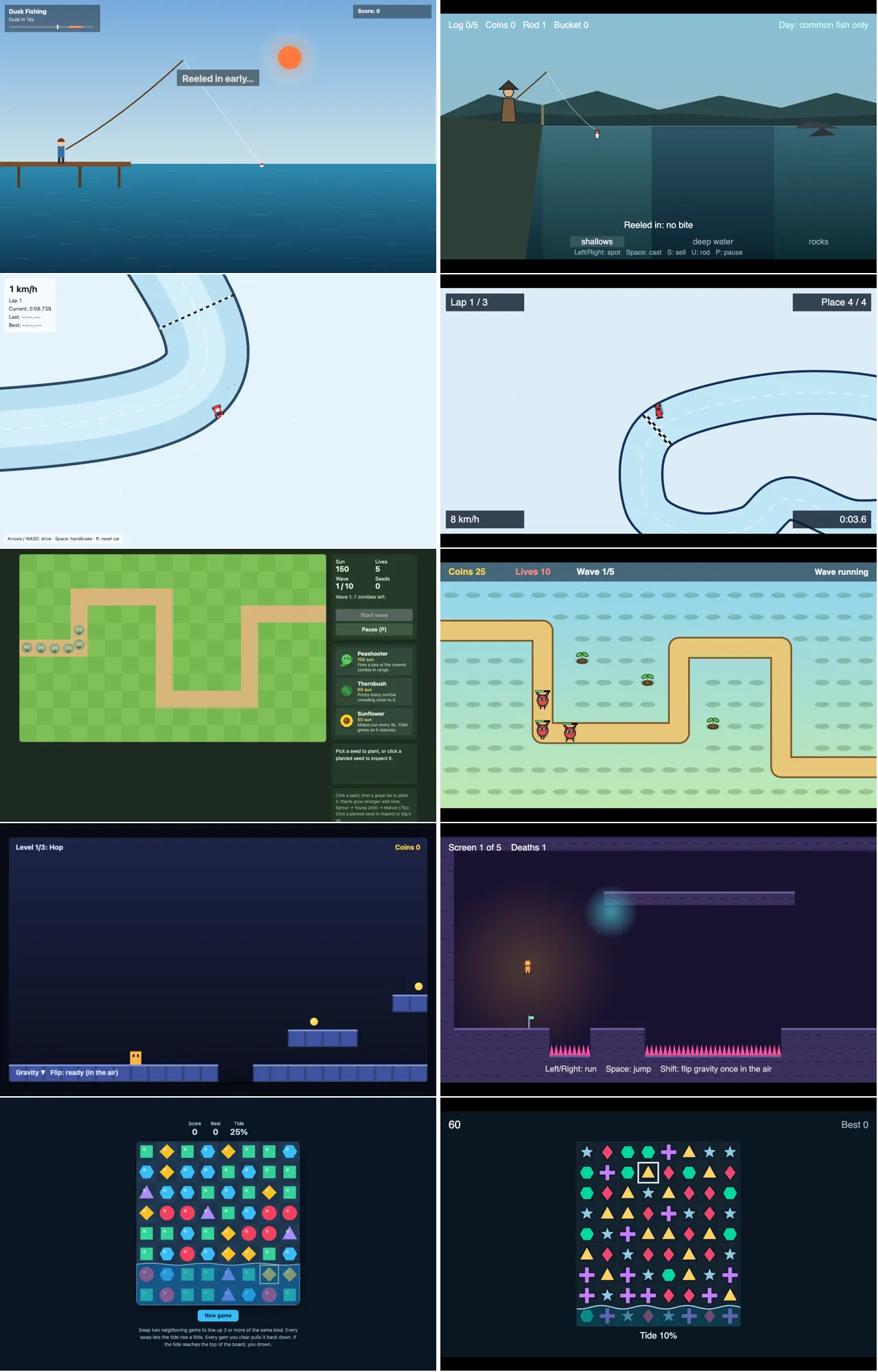
The game code is about the same size in both arms. The difference is around the game:
- The brief. The template writes
brief.mdfirst: your words, the look, the challenge, the controls and the one question the prototype answers. Every answer we skipped is marked provisional. - The tuning file.
config.jsholds speeds, timers and prices, so changing the feel means editing one file. - The self-check. Each game folder has an evidence folder with screenshots and a checklist that marks every line of the brief pass, broken, missing or unassessed. Across the 10 games it marked 185 lines pass, 13 broken, 8 missing and 26 unassessed. Three games listed broken lines, and the handover message said so, ending with a note that a person has yet to play it.
- The opponents. Both template racers put the player in a field of four with AI cars; both plain racers are time trials.
Plain Claude Code’s one failure is worth a look. Its gravity platformer draws the level and waits, and its code leaves the game state unset at load and only the restart key R sets it to play, so Space and clicks take effect only after R. The template’s headless play test, which presses keys and checks that the game responds, is built to catch this kind of fault before handover.
Our picks
A quick toy to try an idea: plain Claude Code. Ask for a playable browser game in one folder. In our runs it built the core mechanic every time in about two minutes for under three cents on Haiku.
A game you plan to keep: Claude Code Game Studios, 39,329 stars and MIT licensed on November 15. Clone it, open Claude Code inside the copy and type /prototype with your idea. The brief, tuning file and checkpoints are what its next steps build on: change it by asking, export a clean copy for itch.io, or grow it into a Vite and TypeScript project one feature at a time.
Somewhere in between: borrow the habits. Ask plain Claude Code for a start screen listing the controls, a pause key and a config object, then open the game in a browser yourself before calling it done.
For more game skills, our game development skills comparison covers Godot, Unity, Phaser and Blender skills from other repos.
What to ignore
- The agent count. The repository advertises 49 agents and 72 workflow skills. The browser game path we tested ran in the main session with one skill, and every game came out of it.
- Lines of code as quality. The two arms wrote about the same amount of game code; the template’s extra value sits in the files around it.
- Our dollar figures as your bill. These are Haiku prices for a first build. A larger model, or the template’s later steps, cost more.
FAQ
What is Claude Code Game Studios?
A repository you copy and open in Claude Code. Its CLAUDE.md, hooks, agents and skills turn a session into a small studio: /prototype asks a round of questions, writes a one-page brief, builds a browser game, plays it headless and hands it over. Later skills grow it, cut scope or prepare a release.
Do I need a game engine?
The browser path needs only Claude Code and a browser; the game opens from index.html. The repository also has an engine route for Godot, Unity and Unreal, which its README says has yet to get the same kind of test, and which we left out.
How many questions does /prototype ask?
In our runs, one round of about eight, picked from the genre: feeling, look, challenge, goal and a few genre choices. Each has a usual answer, so replying that it should pick works, and the brief marks those answers provisional.
Limitations
Twenty runs on one small model, five ideas and two runs each. We judged playability from scripted input, screenshots and code, so whether a game is fun stays outside the measurement. Both arms ran with our user-level Claude Code instructions loaded, which add a project notes file to plain runs.
Reproduce it
The scripts are the run script and the browser check. Clone the template as repo next to a test folder, run python3 run.py <plain|ccgs> <idea> <rep> with Claude Code logged in, start headless Chrome with a debugging port, then node check.mjs <port> <runs folder>. claude-code-game-studios-2026-11.json holds the five ideas and one row per run with cost, time, tokens, page errors, code size, pause and sound, and the template’s own checklist counts.
Sources
- Donchitos/Claude-Code-Game-Studios · official
- Claude-Code-Game-Studios: the prototype skill · official
- Claude Code docs: Agent Skills · official
- AgentCraft: game development agent skills compared · blog